Thursday, October 20, 2022

Don't miss the opportunity to sell during the next upturn

[Editor's note: The boom market for sellers may be over. Interest rates are climbing, the stock market is down. The good, experienced Investment bankers and M&A professionals tell us that unless you have a high-performing company in a highly desirable market, this is NOT the time to sell your business, as valuations continue to fall for companies other than those top performers. They advise companies to spend the time during 2022 and 2023 getting the company in the best shape so that you are ready for the next good M&A market in 2024 -2025.


Some folks believe we are already in a recession. If not yet, many economists expect the next downturn as early as 2023. No one knows for sure. However, there is one thing for sure - if you missed the favorable opportunity to sell once, do not let it happen again.   -DPM]

 Don't miss the opportunity to sell during the next upturn

The full exit sales process may take several years. With credit markets tightening, the economy likely heading into recession, and uncertainty everywhere, it may seem counter-intuitive to be writing about preparing your company to be ready to sell during the next economic upturn.

While some business owners may believe they can pull the string when they are ready, the truth is, for many business owners, the exit sales cycle may take several years to execute. Professionals will tell you that in order to sell at highest value, the process includes 1-2 years to get ready, up to 1 year for the transaction, and then you may have to spend another 3 years with the company after the sale.

Much of the preparation can be accomplished during a down cycle. Companies can focus on making fundamental improvements to their business during the downturn that will help them emerge faster and healthier than their competitors.
1. Focus on customer net profitability
2. Upgrade management
3. Cleanup business processes
4. Develop a strategic growth and execution plan
5. Position the company for the upturn
6. Never waste the opportunity of a good downturn

Customer net profitability.
The tendency during a downturn is to cling to any customers and revenue no matter the profitability level. A common comment is that "at least they absorb overhead." The notion of unprofitable business absorbing overhead may be one of the greatest false beliefs in business. In many cases, overhead that has been viewed as fixed, is really a cost that can be minimized or shed. Carrying unprofitable business will be a continuing cash drain that may inhibit your business' ability to grow as the economy improves.

Upgrade management.
There may be a better supply of good talent available in the marketplace as the economy sours. In many cases, this may be talent that has not be available in better times. Take advantage of the opportunity to improve. This is also a great opportunity to review all of your employees and weed out those with below average performance, poor potential, or unrealized potential. Our clients use a simple tool to rank all employees in terms of potential and performance - the results make it very clear which ones have been a drag on the company.

Cleanup business processes. During boom times, many companies claim they are too busy to scrutinize business processes to make improvements and streamline to increase throughput. That "excuse" typically does not apply during a downturn.

Develop a strategic growth and execution plan. You need a plan not only to help you survive the downturn, but also that will allow you to be agile enough to take advantage of opportunities in the recovering marketplace. There may be market segments that will be slow to come back; some may never come back the same way. Other market segments, however, may present huge new opportunities. Your organization needs to develop a plan and be prepared to execute.

Position your company for the next upturn.
The most significant competitive gains are made during a downturn. Companies that are prepared and well-positioned can accelerate very quickly as he markets healthy. Competitors that are under stress during the downturn will actually be under greater stress as the economy improves. Cash demands can be low when demand is low. Cash needs, however, will increase as the economy improves. Companies will need cash to hire more people, invest in inventory and equipment, etc. 

Never waste the opportunity of a good downturn
During downturns, companies have the opportunity to examine everything, reduce unnecessary expenses, trim those under-performers, examine unprofitable business, streamline business processes, etc. 

Take a lesson from the Boy Scouts: Be prepared.
These steps can add value to your business - even during a downturn. When the economy improves, your business can accelerate faster and be well- positioned. The market for selling a business will be ripe in late 2010 and 2011. Those businesses that are ready will find a hungry group of buyers and investors who have been sitting on their hands during the recession.
_______________________ 
What's the old saying - "Miss your chance once, it's a shame; Miss twice, shame on you!"

We can help. If you have not yet prepared your company ready for sale, we can help. The Mead Consulting Group has been helping companies prepare to maximize value for exit for many years. We have helped over 60 client companies successfully sell outright or recapitalize their business to take "chips off the table." See what some clients have said about their experience with Mead Consulting.

Saturday, October 8, 2022

Execution- Reasons Company Strategies Don't Succeed

 [Editor's Note: Companies are beginning to do strategic planning again. However, almost 2/3 of all strategies fail to reach expectations. Why do so many business strategies fail? Below are some key reasons.

Knowing the barriers in your organization to successful planning and execution is the first step. Clients that follow our recommendations have significantly outperformed the competition. We like to say, "A good plan, well executed, beats a great plan, poorly executed, every time." Contact us if you would like more information.   -dpm]
 
Execution- Reasons Company Strategies Don't Succeed 
 
1. A financial plan or budget is NOT a strategic Plan. While a strategic plan will ultimately lead to financial modeling and a financial plan, many companies confuse the two. We have also seen models that promise great growth without a clear strategy to get there. Without focused strategic direction built around your competitive strengths and market opportunities, financial plans can be merely Excel exercises with little chance for success.
 
2. No clear definition of success 
Fuzzy goals lead to fuzzy outcomes. While it seems obvious, many organizations simply don't articulate the specific goal of a business strategy. If the goal of your customer intimacy strategy is to form deeper customer relationships, that's fuzzy. If the goal is to increase customer retention by 10 percent and increase annual revenue per customer by $10,000 and net profit by $1,000, that's clear. Here, deeper customer relationships may be the mechanism to achieve the goal.

3. Too many goals - Too many "shiny objects" 
When everything is a priority, nothing gets accomplished. Many so-called strategic plans have too many goals, objectives, success drivers, strategies, initiatives and so on. Worse, it's not clear how these various appendages are linked. Is it any surprise these plans sit on shelves and collect dust? Choose to do fewer things much better. Have a "Things we won't do now" list.

4. Metrics and Alignment - Either no metrics or vague metrics 
Many plans are simply a brainstormed list of things to get done by unspecified people at indeterminate times. A plan with specifics outlines who will do what by when. It takes into account the sequencing and timing of tasks, activities and resources. Make certain that the goals of everyone in the organization are aligned to the few key objectives.

5. Visibility - Progress isn't measured and managed 
Ever notice how plans placed in the spotlight flourish while those left in the dark shrivel? Any plan worth executing is worth tracking. A monthly meeting with a tight agenda can quickly determine what actions have been taken; what progress has been made; what will be accomplished over the next month and by whom, and what, if any, challenges have emerged. This builds commitment, accountability and confidence in the process.

6. You lack the right people 
Some of those nice people who work for you may not be the right people to get the job done. That statement makes you uncomfortable, doesn't it? Many have been loyal, are committed to the culture, and may be friends and family. However, if you are truly committed to winning, or achieving success - however you define it - then at some point you have to take a long, hard, honest look at the capabilities of your people. Point them in the right direction, support them, develop them - give them a fair chance to succeed. But if they can't get it done, then your responsibility is to get people who can.

7. Flexibility - Failure to update the plan to stay real 
Reserve the right to do what makes sense. Plans are based on assumptions that can change over time. If they do change, then the plan may need to change. A quarterly "recalibration" meeting is a good forum to test your assumptions and determine which, if any, have changed. The meeting may result in either a re-validation or redesign of the plan. It ensures the plan stays real and relevant.

8. Reaction to Failure - Failure is met with indifference or an inquisition 
Is your team serious about its definition of success? Your response to failure sends a clear message about your commitment to winning. Just as importantly, it sends a message about your credibility. Do you ignore a failed initiative and move on to the next big thing (which conveys that you really weren't that committed and you shouldn't be taken seriously)? Do you look for scapegoats (which communicates that you don't take personal responsibility and can't be trusted)?

Or do you first look in the mirror, take responsibility, then publicly commit to getting it right, and effectively engage your people to make it happen? Your choice speaks volumes about who you are as a leader.

Where does your organization stand? Mead Consulting Group's process begins with the identification of the barriers and obstacles to successful planning and execution. These "barriers" develop in ALL companies over time. In fact, some of the very things that help a company succeed at early levels will prevent them from succeeding at the next level. The key is to address these barriers so that the path is uncluttered.

Understanding the barriers to planning and execution is critical. Companies that have addressed the barriers are amazed at how much more their management teams are engaged and how the process energizes the entire organization. CEOs of companies with years of poor planning and execution history find that their organizations are far more capable than they ever imagined of achieving superior results.
 
The Mead Consulting Group has helped many companies identify and overcome the barriers to successful planning and execution. Our process is simple and effective at uncovering the key obstacles and barriers and developing recommendations for improvement. If you would like to have a conversation about this, please contact Dave Mead at (303)660-8135 or meaddp@meadconsultinggroup.com

Wednesday, September 7, 2022

Are there Barriers to Success Blocking Your Growth and Execution?

 Editor's Note: Several of you asked me to again address the barriers that prevent companies from moving forward and accomplishing real results. I hope you find this helpful in making some fundamental changes. - dpm]

It's September. Your plans for 2023 should be well on their way. Many organizations are beginning the process to think and plan strategies for 2023 and beyond. 
 
What about your organization? Has your company been floating up with the rising tide that floats all boats? What will happen when the tide changes? Ask yourself a few questions:
  •  Does your company's planning process ever yield real results?
  •  Do you go through a long, tedious process year after year that you and your managers dread?
  • Are there barriers in your organization that now protect the status quo and prevent you from moving forward?

Perhaps the approach is flawed!
Years of either poor planning or no planning have created unintended consequences for many organizations. These organizations unintentionally have created barriers that prevent them from developing and executing a meaningful plan. It could be because of a history of unreasonable expectations and unachievable goals, a history of abandoned projects, or a lack of internal knowledge and understanding about customers, competitors, and the market.
Barriers to Planning Success
  •          History of only partially developing plans
  •          History of unreasonable expectations and unachievable goals
  •          Lack of internal understanding about customers, competitors, and the market
 
In addition to barriers to planning, company teams have a lack of confidence and skepticism about their ability to execute plans. This could come from a company history of abandoning projects, a history of unclear objectives and metrics, too many strategies and plans, a history of poor communication, a history of poor delegation and leadership, gaps in management capability, or a lack of true accountability.
Barriers to Execution Success
  •          Gaps in management depth
  •          History of abandoning projects
  •          History of lack of openness and poor communications
  •          History of poor delegation and leadership development
  •          Lack of true accountability
 
Organizations that have barriers to planning and execution have one characteristic in common: there is little or no connection between the plans they create and management behavior around execution. Most management teams quickly get swept away with the urgency of the day-to-day business and the plan is forgotten.
So what can you do to change this counterproductive cycle? Try a better approach!
Consider the following before you start:
  • Fix the barriers
  • Examine past strategic planning and execution efforts
  • Identify the organizational barriers to success - Develop plans to fix these barriers

  • Use a new and flexible approach to strategic planning
  • Less is more - Better to have three strategies with great focus than seven with poor focus
  • Realistic and achievable - Unachievable goals end in frustration and abandonment
  • Validate plans with the market - make certain you understand how customers and competitors will react to your plans

  • Use a better approach to action plans
  • Break into small bites with near-term actions - build momentum by getting some early successes
  • Create 90-day action plans, recheck, and re-evaluate
  • Make Action Plans Clear and Understandable - to everyone in the organization
  • Communicate, Communicate, Communicate
  • Make sure plans and metrics are aligned up and down the organization

  • Measure and Track
  • Metrics - develop quantifiable measurements of progress
  • Track the progress- regular monitoring and adjustment

  •  Adjust and Recalibrate
 
Understanding the barriers to planning and execution is critical. Companies that have addressed the barriers are amazed at how much more their management teams are engaged and how the process energizes the entire organization. CEOs of companies with years of poor planning and execution history find that their organizations are far more capable than they ever imagined of achieving superior results.
 
The Mead Consulting Group has helped many companies identify and overcome the barriers to successful planning and execution. Our process is simple and effective at uncovering the key obstacles and barriers and developing recommendations for improvement. If you would like to have a conversation about this, Contact Dave Mead at (303)660-8135 or meaddp@meadconsultinggroup.com. 

Friday, August 5, 2022

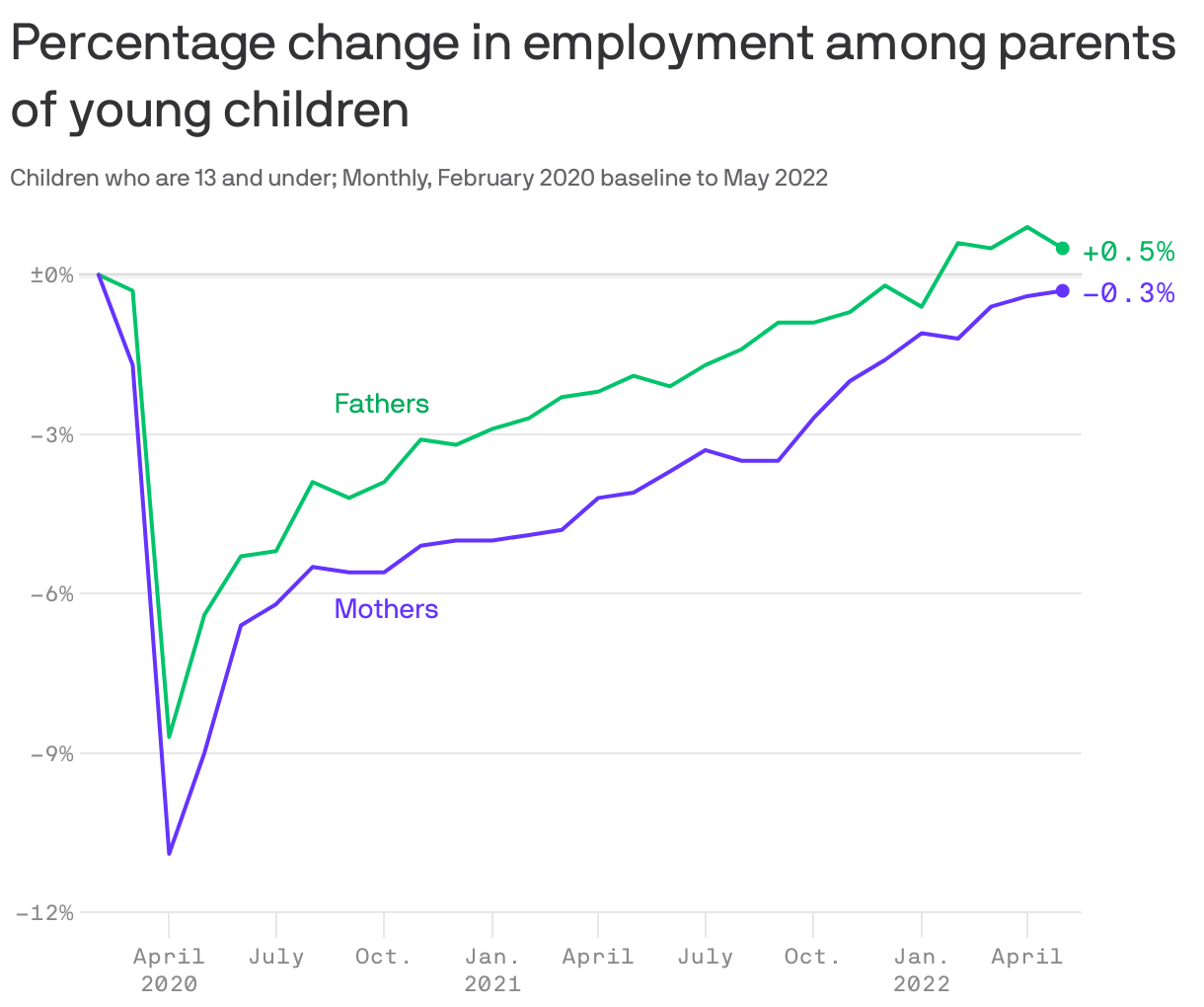
Mothers Still Aren't Fully Back to Work


Data: Indeed analysis of BLS data; Chart: Axios Visuals

Employment levels for mothers of young children are still lagging their pre-pandemic mark, according to a new analysis of women's economic recovery from jobs site Indeed, Emily writes.

  • And overall, women's employment has not yet returned to its February 2020 level — although men's employment has, according to the Bureau of Labor Statistics.

Why it matters: Though women are almost back to where they were before — the reverberations of this era will linger.

  • Women who left the labor market missed out on months of job experience and paychecks — likely to weigh on gender wage disparities for years to come.

On the plus side: The shift to remote work and more flexibility for some workers seems here to say, and has been beneficial to working parents.

Axios Markets

By Matt Phillips and Emily Peck · Jul 19, 2022


Sunday, July 17, 2022

Is the U.S. Labor Market in a "Demographic Desert?"

 Is the U.S. Labor Market in a "Demographic Desert?"

Walk down any street in the United States and you will see “Help Wanted,” “Now Hiring “and “$1,500 hiring Bonus” signs in all directions. While industries like airlines, restaurants and hospitality face extreme shortages of labor, shortages persist in about every segment of the U.S. economy. In May 2022, there were 1.9 job openings per every 1 person unemployed.


A few facts to consider:
  • More Baby Boomers are retiring every day. This accelerated during Covid.
There are currently fifty-two million people in retirement. This trend was exacerbated during the pandemic. In fact, there were 3.3 million more retirees in October 2021 than in January 2020
 
  • International immigration has been decreasing year over year.
According to the US Census Bureau, international immigration in 2021 was 230,000 lower than in 2020 and 324,000 lower than 2019
 
  • Gen Z and the subsequent generations entering the workforce are a smaller cohort than the Baby Boomers

  • Workers are NOT just staying home post pandemic.
The unemployment rate in May was 3.6%. The labor participation rate in May 2022 is now approaching that of February 2020. The exception could be women who are not returning to the workforce due to the high cost/lack of availability of childcare or those who, post-pandemic, have decided to remain at home and home school their children
 

These facts among other conditions do not bode well for a recovery of the labor force any time soon. Now, most demographers and economists who follow demographics are predicting a very tight labor market throughout this decade. Peter Zeihan, a geopolitical strategist, had the depressing prediction that, short of a major downturn or depression, he did not see the labor market “normalizing” until the children of the millennials enter the workforce.

What do you think? Is the U.S. Labor Market in a Demographic Desert? What are the economic implications? What do organizations need to do to adjust? Please comment.

Tuesday, July 5, 2022

Who Is to Blame for Inflation, 1-15


[Editor's Note: “For every complex problem there is an answer that is clear, simple, and wrong.” (H. L. Mencken) I am tired of people looking for a simple answer of who to blame for inflation. The attached article by Barry Ritholtz outlines 15 contributors to our current situation. While I don’t completely agree with the ranking and would add a few additional contributors, it’s a pretty good list. -dpm]

Who Is to Blame for Inflation, 1-15

Who is to blame for the rampant inflation the United States (and the entire world) have been experiencing over the past 12 to 24 months? Which individuals and institutions can we hold accountable for the highest consumer price increases in 40 years?

A variety of people have been asking this question lately. The last time we saw an issue generating this much interest and confusion was when the country tried to understand who was to blame for the Great Financial Crisis (GFC). The approach I used in assigning blame for the 2008-09 financial crisis was based on the premise that the world is complex and ascertaining actual causation is a challenge.1 We can use the same approach to the causes of inflation.

People seem to like simple, binary answers to complex questions. Econ-Twitter will tell you “It’s the Fed’s fault; Blame Biden, no, it’s Trump’s fault.” But the world is a much more complicated place, not easily broken into clear black and white answers — at least, if you value accuracy. Over-simplified faultfinding is more suitable for ideological slogans that fit on bumper stickers than actual economic analysis.

Prices change from moment to moment, but the factors that drive those changes can be years or even decades in the making. We tend to overlook this, caught up as we are in the here & now. The reality is many things have contributed to the current inflationary pressures.

Here are 15 or so drivers of rising prices, roughly in order. Most of the blame goes to those at the top of the list, the bottom of the list are very modest but real contributors:

Inflation Blame

1. Covid-19

2. Congress

3. President Biden CARES Act 3

4. President Trump CARES Acts 1+2

5. Consumers (overspent without regard to cost)

6. Consumers (shift to Goods)

7. Russian Invasion of Ukraine

8. Just in Time Delivery (supply chains)

9. Fed/Monetary Policy

10. Wages/Unemployment Insurance

11. Home Shortages

12. Semiconductors/Automobiles

13. Corporate Profit Seeking

14. Tax Cuts (2017) / Infrastructure (2022)

15. Crypto

Let’s delve into each of these:

Covid-19: The global pandemic – and the response by governments to the deadly and unknown pathogen – created a unique moment in history. A majority of the workforce was unable to go to their offices or workplaces. Essential workers scrambled to service 100s of millions of people stuck at home. This began a cascade of reactions that dramatically changed the structure of the economy, with lasting ramifications.

Without the pandemic, there is no massive fiscal stimulus, no WFH, and no supply chain disruption.

 Fiscal Stimulus: CARES Act 1, 2, & 3 represent the single largest government response to a crisis — ever. Unprecedented in size and scope, the first CARES Act was a $2.2 trillion stimulus bill signed into law by President Trump on March 27, 2020. Next up, CARES Act II was a $900 billion extension of the original stimulus and was signed into law by President Trump on December 27, 2021. CARES Act 3 (aka The American Rescue Plan Act of 2021) was a $1.9 trillion economic stimulus bill signed into law by President Joe Biden on March. 11, 2021.3 It poured even more fuel on an already smoldering fire.

 The first CARES Act legislation was the largest economic stimulus package in U.S. history at more than 10% of U.S. gross domestic product; together with parts II ($900B) and III ($1.9T), and the fiscal stimulus was ~$5 trillion. This is almost seven times the amount of the American Recovery and Reinvestment Act of 2009, the $831 billion signed into law by President Obama in February 2009 in response to the Great Financial Crisis.

All of this fiscal spending was approved by Congress – so while you can argue over the apportionment between Biden & Trump, it is Congress that controls the spending of government, and so deserves much of the blame.

 Goods versus Services: The work from home (WFH) phenomena led to a shift in our consumptive habits: Fewer Services, more Goods. Out: Travel, restaurants, entertainment, vacations, elective (non-emergency) medical care. In: Everything that makes nesting, homeschooling, and WFH more tolerable, from computers and desk chairs. Home extensions and renovation led to a massive increase in demand for lumber, landscaping materials, raw building materials, appliances, and furniture.

The shortage of starter yeast revealed just how radically consumption had changed.

The pandemic lockdown moved the consumer towards goods and away from services. Pre-pandemic, consumers spent 38.7% on Goods, but a whopping 61.3% on Services. In 2020, the demand for Goods rose 20% globally, but production increases were barely 5%. Prices rose accordingly.

As an economy, we suddenly began buying food via Instacart/Amazon/Target/Walmart instead of going out to eat; we bought Peletons vs. a gym membership; we purchased large screen TVs instead of going to the movies; we bought cars and Winnebagos instead of going on vacation. Perhaps it’s a good sign that used Pelotons can be found on eBay for a fraction of what they cost new.

Russian Invasion of Ukraine: Foods and energy prices were already elevated pre-invasion, but Putin supercharged their prices. Until this war ends, energy prices will likely remain elevated as will grain and other foodstuffs.

Consumers: People driving during rush hour complain about being “stuck in traffic.” They are not stuck in traffic, they are traffic. A similar paradigm applies to inflation: Consumers who continue to buy Homes and Cars despite substantial price increases are not suffering from inflation, they are (in part) a driver of inflation.

Think about the purchases of homes or used cars, despite price increases that range from substantial to outright ridiculous. When you buy a good, despite big increases, demand can be described as “inelastic.” So you (over)pay an inflated price in order to get the necessitated item. It may feel like you’re suffering from inflation (just as in traffic) but recognize you are also a source of inflation.

Just in Time Delivery/ Inventory shortfall: In the relentless effort to become more efficient and profitable, warehousing inventory became anathema to corporate managers. This dramatically reduced inventory costs but required logistics and supply chains to be incredibly robust. As it turns out, they were not. [Mead comment: Too many purchasing mand supply chain managers violated Purchasing Rule 101 - Having multiple sources of supply. There were no alternate sources identifies and ready to scale up when the primary sources dried up.]

Semiconductors (Autos): Reopening a temporarily closed chip fab is a complicated expensive process. In 2021, the shortage of New and Used Cars was among the largest contributors to price increases.

Housing: We underestimated demand for single-family homes, and then underbuilt them for a decade. Suddenly lots of people wanted one. The large price increases on admittedly smaller volumes are the result. The Eviction Moratorium also plays into this; the unintended consequences may be that landlords are raising apartment rents in order to catch up on lost revenues from nonpaying renters from 2020-21.

For some context, BLS reports that in 2021, on the days they worked, 38% of employed persons did some or all of their work at home; 68% did some or all of their work at their workplace. Compare that to the pre-COVID-19 pandemic era on 2019: Workers were less likely to work at home (24%) and much more likely to work at their workplace (82%).

Wages: For the past 4 decades, the bottom half of the wage scale lagged dramatically. The minimum wage contributed to Deflation. But nothing is forever, and the circumstances of that power dynamic have turned. Workers,especially the bottom half of paid employees, seem to have gained the upper hand. (We discussed this in April of 2021).

Unemployment Insurance: When you give Americans $1.4 trillion in Unemployment, they tend to not want to work for $8 or $10 an hour. And, they form new businesses in record numbers.

Fed/Monetary Policy: ZIRP QE did nothing for inflation for a decade-plus, so it’s hard to have them at the top of the list. (I know this back of the list placement will infuriate Fed haters, but I am aiming for accuracy). But once the fiscal stimulus kicked in, the Fed was somewhat behind the curve. At the very least, thru should have been normalizing rates back in 2021.

Tax Cuts / Infrastructure: For the sake of completeness, I am including the Tax Cuts and Jobs Act (TCJA) ($1.1 trillion, annually, from 2018 forward) and the 2022 Infrastructure bill (minimum $1.1 trillion over 10 years). I do not believe these are big contributors to the current bout of rising prices, but it’s just that much more fiscal fuel for the fire.

Corporate Profit Seeking: I am not in the camp that seeks to place blame on rising prices in companies seeking to increase their revenue and profits. However, as a consumer of goods, one cannot help but notice substantial price increases in items that have very little to do with input costs, supply chain snafus, or semiconductor production shortfalls. While transportation costs affect all goods, some of the price rises we’ve seen are simply people taking advantage of inflation to raise their own prices.

You can’t have a capitalist system where companies, shareholders and their management are rewarded for profitability and not end up with some dubious behavior/profiteering on the margins. But I doubt it adds up to very much, best guess maybe 5-10% of the increases (if anyone has data showing more, I’d be curious to see it).

Crypto: Why is crypto on this list? 4 Because massive gains led to a series of big spends – from $100 million mansions as Hedge funds and VCs cashed in; but do not ignore the starter homes, where Redfin found “11.6% of people buying homes for the first time said that selling investments in cryptocurrency had helped them save for a down payment.”

Lamborghinis have been sold out for 2 years, and (anecdotally) crypto profits are driving at least some of that. Some of the larger dealerships are accepting crypto as a form of payment.

The world is complex, but the human mind seems to prefer simplicity, even at the expense of accuracy. As much as we want to point a finger at a single person – whether it’s for partisan reasons or simply as a way of expressing our angst – this is simply not how economies in the real world actually work.

The truth is we have many factors leading to higher prices – and some of them are showing signs of peaking.

 by Barry Ritholtz, June 28,2022

__________________________


Tuesday, June 14, 2022

Lessons my Father taught me

 Lessons my Father taught me

 
As we approach Father’s Day, I am preoccupied with thoughts about the memory of my father. While Dad passed away over more than 40 years ago, not a day goes by that I do not actively think about the lessons I learned from him. 
 
Here are some of the lessons in no particular order – and if you knew my father you’d know it certainly is not a comprehensive list.
 
  • Always leave it better than you found it - make a difference
  • Treat others the way you want to be treated 
  • If you keep your mouth open long enough, something unfortunate will come out     
  • Do your best and, if you keep trying, you’ll be the best
  • Do the important things first … and the less important will take care of themselves
  •  Do what you know is right
  • Never ever give up
  • The Lord helps those who help themselves
  • Birds of a feather flock together
  • You are judged by the company you keep
  • There are no boring jobs, only boring people
  • Always do more than is expected
  • Never let a “wrong” go unaddressed
  • Learn something new every day
  • If you teach a person to fish, he’ll never be hungry
  • And the most important lesson: Most people see things as only black and white. The most successful people are able to see the myriad shades of gray.

Happy Father's Day!